
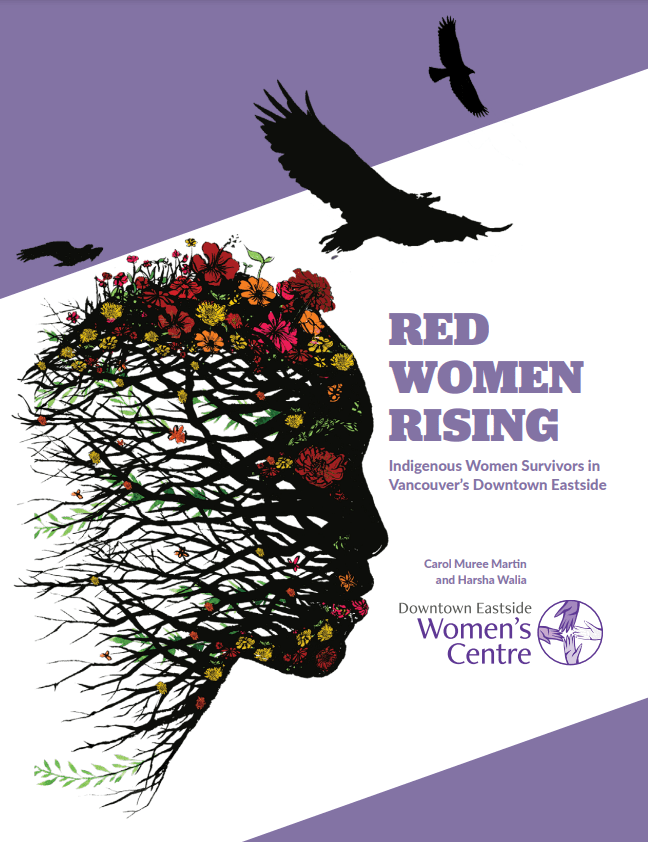
In 2019, the Downtown Eastside Women’s Centre published the report entitled “RED WOMEN RISING: Indigenous Women Survivors in Vancouver’s Downtown Eastside” and written by Carol Muree Martin (Nisga’a – Gitanyow) and Harsha Walia. This report is the first comprehensive project with Indigenous women survivors in the DTES figuring at the very centre of community research, rather than as a secondary statistic.
139 search results
for
Decolonization and Indigenous rights
Full Indigenous jurisdiction
Recommendation 1: Implementation of the United Nations Declaration on the Rights of Indigenous Peoples at all levels of government; assertion of Aboriginal Title over lands; jurisdiction over all areas of law-making; and restoration of collective Indigenous women’s rights and governance.-
Category and theme:
Audience:
Groups affected:
Location of recommendation:
Active Indigenous women’s leadership
Recommendation 2: All levels of Canadian government, national aboriginal organizations, and nonprofit agencies must ensure the active leadership of Indigenous women in the design, implementation, and review of programs and policies that are directed to increase the safety of Indigenous women. Strengthen and support solutions that restore the role of Indigenous women, girls, and two-spirit people as Title-holders of their lands, traditional knowledge keepers, sacred life-givers, and matriarchs within extended kinship networks.-
Category and theme:
Audience:
Groups affected:
Location of recommendation:
Eliminating structural violence against Indigenous women and girls
Recommendation 3: Increased state enforcement alone cannot eliminate violence against Indigenous women and girls because structural violence is connected to individual acts of male violence. A comprehensive national-level integrated action plan to eliminate violence against Indigenous women and girls must address all the socio-economic factors impacting Indigenous women’s, girls’, trans and two-spirit’s safety including equitable access and self-determination over land, culture, language, housing, child care, income security, employment, education, and physical, mental, sexual and spiritual health.-
Category and theme:
Audience:
Groups affected:
Location of recommendation:
Legislative reform to reduce Indigenous women’s manufactured vulnerability
Recommendation 4: Implement independent civilian oversight of officials responsible for responding to and investigating violence against Indigenous women. Ensure that administrative, disciplinary, or criminal measures are available to hold such officials accountable when officers are found to have failed to act on reports of missing women or to have carried out biased or inadequate investigations of violence against Indigenous women.-
Category and theme:
- Access to justice ,
- Courts ,
- Decolonization and Indigenous rights ,
- Discrimination and hate ,
- Gender-based violence ,
- Health, wellness and services ,
- Human rights system ,
- Indigenous issues in policing and justice ,
- Missing and murdered Indigenous women, girls, Two-Spirit, and LGBTQ2SIA+ people ,
- Policing ,
- Policing and the criminal justice system ,
- Sexism
Audience:
Groups affected:
Location of recommendation:
Legislative reform to reduce Indigenous women’s manufactured vulnerability
Recommendation 5: Remove discrimination from the Indian Act by making women and men equal in the ability to pass on status, repair situations where discrimination against women has disadvantaged those claiming status through the mother’s line, and remove the two-parent rule for transmitting status and the 6(2) cutoff that withholds status from the children of many women who are unable or unwilling to provide the father’s name.-
Category and theme:
Audience:
Groups affected:
Location of recommendation:
Legislative reform to reduce Indigenous women’s manufactured vulnerability
Recommendation 6: End the apprehension of Indigenous children and prohibit the placement of Indigenous children into non-Indigenous foster and adoptive families.-
Category and theme:
Audience:
Groups affected:
Location of recommendation:
Legislative reform to reduce Indigenous women’s manufactured vulnerability
Recommendation 7: Require Gladue factors to be used as mitigating factors only, unless the victim is an Indigenous woman in which case her wishes should take precedence over an offender.-
Category and theme:
Audience:
Groups affected:
Location of recommendation:
Legislative reform to reduce Indigenous women’s manufactured vulnerability
Recommendation 8: End the policing practice of street checks; reduce the number of bylaw infraction tickets issued by police in the DTES; prohibit police from carrying and using all lethal weapons; develop guidelines to facilitate greater use of police discretion not to lay charges especially for minor poverty-related offences; and end the counter-charging and criminalization of Indigenous women who defend themselves or their children.-
Category and theme:
- Access to justice ,
- Classism ,
- Decolonization and Indigenous rights ,
- Discrimination and hate ,
- Economic inequality ,
- Human rights system ,
- Indigenous children and youth in care ,
- Indigenous issues in policing and justice ,
- Indigenous rights and self-governance ,
- Policing and the criminal justice system ,
- Poverty ,
- Poverty and economic inequality ,
- Sexism
Groups affected:
Location of recommendation:
Legislative reform to reduce Indigenous women’s manufactured vulnerability
Recommendation 9: Commit to using non-incarceration and alternative measures especially for minor offenses committed by Indigenous women. Governments must also provide sufficient and stable funding to Indigenous communities and organizations to provide alternatives to incarceration including community-based rehabilitation, diversion, community courts, and restorative justice methods geared towards Indigenous women.-
Category and theme:
Audience:
Groups affected:
Location of recommendation:
Recommendation 15:
Implement an Indigenous reparations tax on top of property taxes on residential, commercial, and industrial properties, with all revenues going to implementation of an Indigenous poverty reduction plan.
-
Category and theme:
Groups affected:
Location of recommendation: