

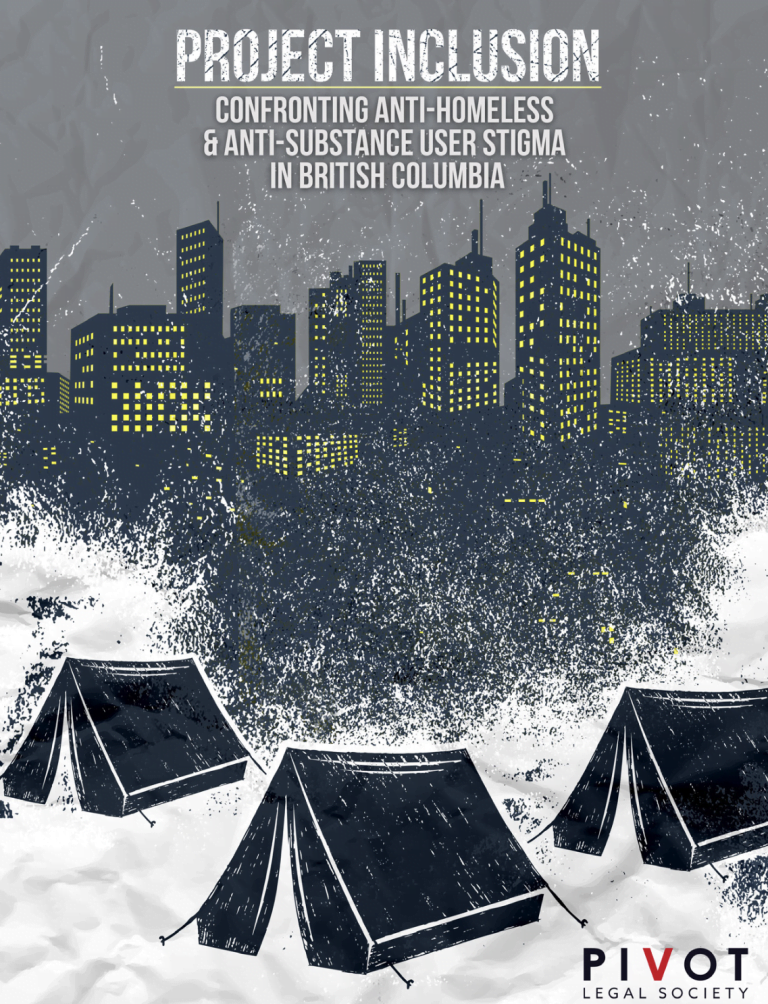
In December 2018, Pivot Legal Society published their comprehensive study, “Project Inclusion: Confronting Anti-Homeless and Anti-Substance User Stigma in British Columbia.” The report examines the ways in which specific laws and policies in policing, health care and the court system directly undermine the health and safety of people who are homeless and living with substance use issues by trapping them in a cycle of criminalization.
23 search results
for
Discrimination and hate
The impacts of police and policing
The Attorney General must take immediate action to increase access to justice for people who believe they have been the victims of excessive force, discrimination, or harassment by police by:
Recommendation 3: Amending the Police Act to expand the mandate of the Office of the Police Complaint Commissioner (OPCC) in order to:- ensure that all police officers and forces operating in BC fall under the mandate of the OPCC;
- ensure that civilian investigators and civilian staff members are responsible for the entirety of the complaint resolution process; and
- allow the OPCC to audit police complaints each year, particularly where they involve discrimination based on race, gender, poverty, or health status, and publicly report on areas of concern for further investigation or reform.
-
Category and theme:
Audience:
Groups affected:
Location of recommendation:
The impacts of police and policing
The Director of Police Services must develop the following Provincial Policies for all policing agencies in British Columbia:
Recommendation 5: A Provincial Policy on harm reduction which should include:- a directive to deprioritize simple possession of controlled substances and an overview of the harms of confiscating substances (including alcohol) from people with addictions and limited resources;
- a directive to never confiscate new or used syringes, naloxone, and other harm reduction and overdose prevention supplies;
- a statement that harm reduction supplies, whether new or used, are not a basis for search or investigation; and
- a directive that local police forces work with service providers to develop bubble zones around safe consumption sites, overdose prevention sites, and other harm reduction sites, taking into consideration policing practices that may deter access including visible presence, arrests in close proximity, undercover operations in and near, and surveillance of people using the service.
-
Category and theme:
Groups affected:
Location of recommendation:
The impacts of police and policing
The Director of Police Services must develop the following Provincial Policies for all policing agencies in British Columbia:
Recommendation 7: A Provincial Policy on confiscation of belongings by police which includes:- a strong statement that explains to all police forces the harm caused by the confiscation of homeless people’s belongings;
- deprioritize confiscating homeless people’s belongings, especially necessities of life such as shelter, clothing, medication, and important personal items; and
- a directive to issue receipts for belongings and cash where they must be taken, with instructions for how to get them back.
-
Category and theme:
Groups affected:
Location of recommendation:
The impacts of police and policing
The Director of Police Services must develop the following Provincial Policies for all policing agencies in British Columbia:
Recommendation 8: A Provincial Policy detailing people’s right to privacy in tents and informal living structures akin to the right to privacy in private residences.-
Category and theme:
Groups affected:
Location of recommendation:
The impacts of police and policing
Recommendation 9: The Director of Police Services must work with the Independent Investigations Office and the Coroners Service to audit deaths and serious injuries in city cells in BC over the past 10 years, including an analysis of race, disability, housing status, and gender, and, make the findings and recommendations for reform publicly available.-
Category and theme:
Groups affected:
Location of recommendation:
The impacts of police and policing
Recommendation 10: The Ministry of Housing and Municipal Affairs (MHMA) must make a province-wide commitment to supporting homeless people to maintain their belongings and to ensuring that homeless people have access to services without fear of losing their possessions. The MHMA must partner with local governments in collaboration with groups of people with lived experience, to train local bylaw officers:- to recognize and respect the belongings of homeless people; and
- to work effectively with people experiencing homelessness to clean up or discard belongings where there is a pressing public safety, access, or environmental need to do so.
-
Category and theme:
Groups affected:
Location of recommendation:
The impacts of police and policing
Recommendation 11: The Ministry of Public Safety and Solicitor General, in partnership with the MHMA, should issue a directive stating that no public funds may be used for private security patrols on public property, including in public parks.-
Category and theme:
Groups affected:
Location of recommendation:
How court-imposed conditions set people up to fail
Recommendation 12: The Government of Canada must amend the Criminal Code to prevent the use and prosecution of discriminatory or destructive behavioural conditions of interim release and sentencing, specifically:- legislate that conditions imposed on interim release be reasonable and proportionate to the nature and seriousness of the alleged offence and the circumstances of the accused;
- define “drug paraphernalia” as harm reduction medical equipment and prohibit the imposition of conditions that would interfere with the ability to access or possess harm reduction equipment;
- prior to imposing an abstinence condition, require that courts consider a person’s dependence on drugs or alcohol. Abstinence conditions shall not be imposed on people living with addictions, except where doing so is necessary to protect the safety of a victim, witness, or the public, and harm-reduction measures shall be preferred over abstinence;
- limit “red zone” conditions to situations where there is a substantial likelihood that, if released without a red zone, the accused will commit an offence involving violence or serious harm within the red zone and ensure that any red zone is tailored to the alleged offence, the principles of judicial interim release or probation, and circumstances of the individual;
- remove paragraph 504(2.1) (g), the power for police to impose “abstinence” conditions; and
- eliminate criminal sanctions for non-violent breaches of behavioural conditions.
-
Category and theme:
Audience:
Groups affected:
Location of recommendation:
How court-imposed conditions set people up to fail
The Governments of BC and Canada must amend their prosecutorial policy, specifically:
Recommendation 13: Amend the BC Crown Counsel Policy Manual to include a policy on “Conditions of Release” that:- aligns with the Criminal Code requirement that an accused be released unconditionally unless their detention or the imposition of conditions is justified;
- reflects Supreme Court of Canada jurisprudence requiring that conditions of release be minimally onerous and that every imposition of more restrictive conditions must be individually justified; and
- takes into consideration the potential harms of imposing certain conditions on some individuals based on their social condition, race, ability status, housing status, and substance use.
-
Category and theme:
Groups affected:
Location of recommendation:
How court-imposed conditions set people up to fail
The Governments of BC and Canada must amend their prosecutorial policy, specifically:
Recommendation 15: Amend the Public Prosecution Service of Canada Deskbook Part 3.18 sections 2 and 5 to:- more clearly reflect the Criminal Code requirement that an accused be released unconditionally unless their detention or the imposition of conditions is justified; and
- take into consideration the potential harms of imposing certain conditions on certain individuals based on their social condition, race, ability status, housing status, and substance use. ii. take into consideration the potential harms of imposing certain conditions on certain individuals based on their social condition, race, ability status, housing status, and substance use.
-
Category and theme:
Groups affected:
Location of recommendation: