
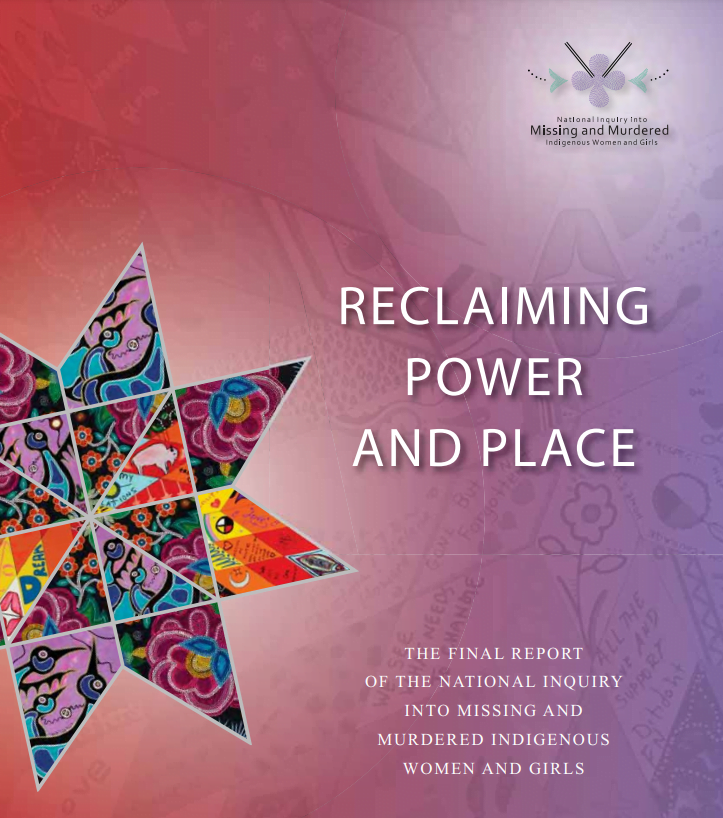
In June 2019, The National Inquiry into Missing and Murdered Indigenous Women and Girls published their final report, “Reclaiming Power and Place,” which is comprised of the truths of more than 2,380 family members, survivors of violence, experts and Knowledge Keepers shared over two years of cross-country public hearings and evidence gathering. The two-volume report calls for transformative legal and social changes to resolve the crisis resulting from persistent and deliberate human and Indigenous rights violations and abuses.
63 search results
for
Discrimination and hate
All governments
Human and Indigenous rights and governmental obligations
Recommendation 1: We call upon federal, provincial, territorial, municipal, and Indigenous governments (hereinafter “all governments”), in partnership with Indigenous Peoples, to develop and implement a National Action Plan to address violence against Indigenous women, girls, and 2SLGBTQQIA people, as recommended in our Interim Report and in support of existing recommendations by other bodies of inquiry and other reports. As part of the National Action Plan, we call upon all governments to ensure that equitable access to basic rights such as employment, housing, education, safety, and health care is recognized as a fundamental means of protecting Indigenous and human rights, resourced and supported as rights-based programs founded on substantive equality. All programs must be no-barrier, and must apply regardless of Status or location.Governments should:
- Table and implement a National Action Plan that is flexible and distinctions-based, and that includes regionally specific plans with devoted funding and timetables for implementation that are rooted in the local cultures and communities of diverse Indigenous identities, with measurable goals and necessary resources dedicated to capacity building, sustainability, and long-term solutions; and
- Make publicly available on an annual basis reports of ongoing actions and developments in measurable goals related to the National Action Plan.
-
Category and theme:
- Access to justice ,
- Accessibility ,
- Accessible services and technology ,
- Culture and language ,
- Decolonization and Indigenous rights ,
- Discrimination and hate ,
- Economic inequality ,
- Education and employment ,
- Gender-based violence ,
- Health, wellness and services ,
- Housing and homelessness ,
- Human rights system ,
- Indigenous rights and self-governance ,
- Missing and murdered Indigenous women, girls, Two-Spirit, and LGBTQ2SIA+ people ,
- Poverty and economic inequality ,
- Public services
Audience:
Groups affected:
Location of recommendation:
All governments
Human and Indigenous rights and governmental obligations
Recommendation 2: We call upon all governments, with the full participation of Indigenous women, girls, and 2SLGBTQQIA people, to immediately implement and fully comply with all relevant rights instruments, including but not limited to:- ICCPR, ICESCR, UNCRC, CEDAW, and ICERD, as well as all optional protocols to these instruments, including the 3rd Protocol to the United Nations Convention on the Rights of the Child (UNCRC);
- American Convention on Human Rights: specifically, that Canada ratify the American Convention on Human Rights and the Inter-American Convention on the Prevention, Punishment, and Eradication of Violence against Women;
- All the recommendations of the 2015 UN CEDAW Inquiry Report and cooperation with the UN Committee on the Elimination of Discrimination against Women on all follow-up procedures;
- All recommendations made by international human rights bodies, including treaty-monitoring bodies, on causes and recommendations to address violence against all, but specifically Indigenous women, girls, and 2SLGBTQQIA individuals; and
- UNDRIP, including recognition, protection, and support of Indigenous self-governance and self-determination, as defined by UNDRIP and by Indigenous Peoples, including that these rights are guaranteed equally to women and men, as rights protected under section 35 of the Constitution. This requires respecting and making space for Indigenous self-determination and self-governance, and the free, prior, and informed consent of Indigenous Peoples to all decision-making processes that affect them, eliminating gender discrimination in the Indian Act, and amending the Constitution to bring it into conformity with UNDRIP.
-
Category and theme:
- Access to justice ,
- Decolonization and Indigenous rights ,
- Discrimination and hate ,
- Gender-based violence ,
- Human rights system ,
- Indigenous children and youth in care ,
- Indigenous rights and self-governance ,
- International human rights ,
- Missing and murdered Indigenous women, girls, Two-Spirit, and LGBTQ2SIA+ people
Audience:
Groups affected:
Location of recommendation:
All governments
Human and Indigenous rights and governmental obligations
Recommendation 3: We call upon all governments, in meeting human and Indigenous rights obligations, to pursue prioritization and resourcing of the measures required to eliminate the social, economic, cultural, and political marginalization of Indigenous women, girls, and 2SLGBTQQIA people when developing budgets and determining government activities and priorities.-
Category and theme:
Audience:
Groups affected:
Location of recommendation:
All governments
Human and Indigenous rights and governmental obligations
Recommendation 4: We call upon all governments, and in particular Indigenous governments and Indigenous representative organizations, to take urgent and special measures to ensure that Indigenous women, girls, and 2SLGBTQQIA people are represented in governance and that their political rights are respected and upheld. We call upon all governments to equitably support and promote the role of Indigenous women, girls, and 2SLGBTQQIA people in governance and leadership. These efforts must include the development of policies and procedures to protect Indigenous women, girls, and 2SLGBTQQIA people against sexism, homophobia, transphobia, and racism within political life.-
Category and theme:
Audience:
Groups affected:
Location of recommendation:
All governments
Human and Indigenous rights and governmental obligations
Recommendation 5: We call upon all governments to immediately take all necessary measures to prevent, investigate, punish, and compensate for violence against Indigenous women, girls, and 2SLGBTQQIA people.-
Category and theme:
Audience:
Groups affected:
Location of recommendation:
All governments
Human and Indigenous rights and governmental obligations
Recommendation 6: We call upon all governments to eliminate jurisdictional gaps and neglect that result in the denial of services, or improperly regulated and delivered services, that address the social, economic, political, and cultural marginalization of, and violence against, Indigenous women, girls, and 2SLGBTQQIA people.-
Category and theme:
Audience:
Groups affected:
Location of recommendation:
All governments
Human and Indigenous rights and governmental obligations
Recommendation 8: We call upon all governments to create specific and long-term funding, available to Indigenous communities and organizations, to create, deliver, and disseminate prevention programs, education, and awareness campaigns designed for Indigenous communities and families related to violence prevention and combatting lateral violence. Core and sustainable funding, as opposed to program funding, must be provided to national and regional Indigenous women’s and 2SLGBTQQIA people’s organizations.-
Category and theme:
Audience:
Groups affected:
Location of recommendation:
All governments
Human and Indigenous rights and governmental obligations
Recommendation 9: We call upon all governments to develop laws, policies, and public education campaigns to challenge the acceptance and normalization of violence.-
Category and theme:
Audience:
Groups affected:
Location of recommendation:
All governments
Culture
Recommendation 17: We call upon all governments to educate their citizens about, and to confront and eliminate, racism, sexism, homophobia, and transphobia. To accomplish this, the federal government, in partnership with Indigenous Peoples and provincial and territorial governments, must develop and implement an Anti-Racism and Anti Sexism National Action Plan to end racist and sexualized stereotypes of Indigenous women, girls, and 2SLGBTQQIA people. The plan must target the general public as well as public services.-
Category and theme:
Audience:
Groups affected:
Location of recommendation:
All governments
Health and wellness
Recommendation 19: We call upon all governments to ensure that the rights to health and wellness of Indigenous Peoples, and specifically of Indigenous women, girls, and 2SLGBTQQIA people, are recognized and protected on an equitable basis.-
Category and theme:
Audience:
Groups affected:
Location of recommendation: